This is site is maintained by ERWIN ONYAMBU MOGUSU

Your comment will be highly appreciated,you can contact me on +254733810371 or omogusu@gmail.com.

Erwin in South Korea

Interacting with the Korean students.

ERWIN O. MOGUSU

At Chuncheon National University of Education in South Korea.

Elementally school pupils

Kenyan teachers pose for a photo with the Korean school children.

Travelling to Korea

At Dubai International Airport.

Sunday, 11 August 2019

Structure of the atom and the periodic table

1. In an experiment an unknown mass of anhydrous sodium carbonate was dissolved in water and the solution made up to 250cm3. 25cm3 of this solution neutralized 20cm of 0.25M nitric acid.
(Na = 23.0 C = 12.0 O = 16.0)
Calculate:
(a) Moles of Nitric acid used
(b) Moles of sodium carbonate in 25cm of the solution
(c) Mass of unknown sodium carbonate used

2. Element A has atomic mass 23 and element B has atomic mass 7 and also have 12neutorns and 4 neutrons respectively.
(a) Write the electronic arrangement of A and B
(b) Which element has higher ionization energy? Explain

3. The table below shows the relative atomic masses and the percentage abundance of isotope M1 and M2 of element M.

Calculate the relative atomic mass of element M

4. (a) Element V has two isotopes. Two thirds of V and one third of V . What is the relative atomic mass of element V?
(b) The following refers to element Y
Given that isotope C contains 31 neutrons in its nucleus find the number of protons in isotope B

5. The table below shows the relative atomic masses and the percentage abundance of the isotopes L1 and L2 of element L.
Calculate the relative atomic mass of element K.

6. An element M has two isotopes M and M . The relative atomic mass of the naturally occurring is 63.55. Calculate the percentage of each isotope

7. An oxide of element G has the formula as G2O3 
(a) State the valency of element G
(b) In which group f the periodic table is element G?

8. The table below gives information about the ions T+ and Z2-
(a) How many protons are there in the nucleus of ?
(i) Element T?
(ii) Element Z?
(b) Determine the relative formula mass of the compound formed between T and Z
(c) State two conditions under which the compound would conduct electricity

9. Carbon and silicon belong to the same group of the periodic table, yet Carbon (IV) oxide is a gas while silicon (IV) oxide is a solid with a high melting point. Explain this difference

10. An ion of oxygen is larger than oxygen atom. Explain

11. Copper (II) oxide and charcoal are black solids. How would you distinguish between the two solids?

12. (a) Element X is found in period III and group IV. It consists of two isotopes 28X and QX. A sample of X was found to consist of 90% of 28X.If the relative atomic mass of X is 28.3, work out the number of neutrons in QX
(b) Draw an electrochemical cell for the above cell

13. Study the table below and answer the questions that follows:- (Letters are not the actual
symbols of element)
       L3 has the highest electrical conductivity. Explain

14. Define the term melting point of a substance

15. Use the information in the table below to answer the questions that follow. (The letters do not represent the actual symbols of the elements).

(a) Which two letters represent the same element? Give a reason
(b) Give the number of neutrons in an atom of element R

16. The table below gives some elements in the periodic table. Use it to answer the questions that Follow. The letters do not represent the actual symbols of the elements.
Which of the above letters represent:
a) A metallic element which forms ions with the smallest ionic radius? Explain
b) A non metallic element with the largest bbatomic size? Explain

17. The grid below is part of the periodic table. Use it to answer the questions that follow: (The letters are not the actual symbols).
a) Write down the formula of the compound formed between C and A.
b) Which element has the same electron arrangement as the stable ion of:
(i) F ……………………………. (ii) A ……………………..
c) Element Q has atomic number 15. Indicate its position on the grid.
d) Explain how the atomic radii of the following compare:
(i) C and F
(ii) C and D
e) Write the type of bond present in a compound formed between D and A.
f) Compound C and G were completely burned in oxygen.
(i) Write down equations to show the combustion of each of the elements.
(ii) State whether each of the oxides (i) above is basic or acidic.

18. The following flow chart shows the industrial manufacture of Nitric (V) acid.
a) Identify substance B, C, E and F.
b) Describe what happens in the catalytic chamber.
c) State what takes place in chamber D.
d) 60 – 65% nitric (V) acid is produced in the absorption chamber. Describe how the acid can be concentrated.
e) State why nitric (V) acid is stored in dark bottles.
f) Copper reacts with nitric (V) acid and not hydrochloric acid. Explain.

19. The number of protons, neutrons and electrons in atoms A to F are given in the table below
the letters do not represent the actual symbol of the elements:-
(a) Choose from the table the letters that represent:
(i) An atom of a metal ..........................................................
(ii) A neutral atom of a non-metal ........................................
(iii) An atom of a noble gas ..................................................
(iv) A pair of isotopes ............................................................
(v) A cation ...............................................................................
(b) The grid below shows a part of the periodic table. The letters do not represent the actual
symbols.
Use it to answer the questions that follow:-
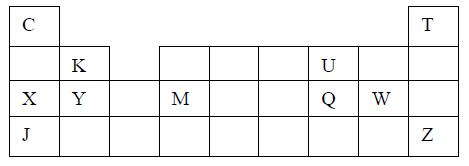
(a) How do the atomic radius of element X and Y compare
(b) (i) Using crosses (X) to represent electrons, draw the atomic structure of element Q
(ii) State the period and the group to which element Q belong
(c) (i) The ionic configuration of element G is 2.8 G forms an ion of the type G-1.  
Indicate on the grid, the position of element G.
(ii) To which chemical family does element G belong?
(iii) State one use of element U
(iv) What is the nature of the compound formed between K and U
20. (a) Study the table below and answer the questions that follow.

(i) Complete the table above
(ii) From the table, choose the most reactive metal. Explain
(iii) Which element is the most electronegative. Explain
(iv) Using dots (.) and crosses (x) to represent electrons, show the bonding in the chloride of Q
(v) Explain the solubility of element T in water
(b) (i) Why is aluminium used to make utensils yet it is a reactive metal?
(ii) Distinguish between valency and oxidation number

21. a) Work out the oxidation number of phosphorous in the following compound H3PO3
b) Study the equation below:
            
Which species has undergone oxidation .Explain

22. The grid below represents part of the periodic table. The letters do not represent the actual
symbols of the elements. Study it and answer the questions that follow:

(a) Explain why element L appears in two different groups in the grid above
(b) State the name of the chemical family to which P and Q belong
(c) Write the formula of the compound formed between P and V
(d) Compare the melting points of Q and S. Explain
(e) Identify an element whose oxide dissolves in both acids and alkalis
(f) Write the equation for the burning of T in excess air
(g) Using dots (•) and cross (x) to represent electrons, draw a diagram to illustrate bonding in the sulphide of Q
(h) State one use of element X

23. The grid below represents part of the periodic table. Study it and answer the questions that follow:
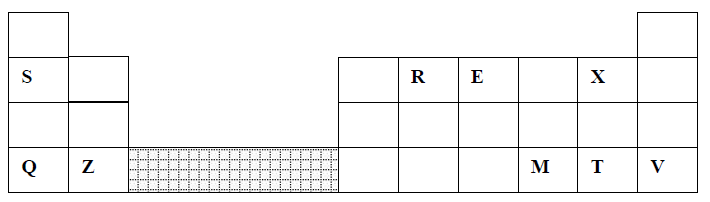
(a) (i) Identify the element that gains electrons most readily
(ii) Which of the metal is most reactive? Explain
(iii) What name is given to the family of elements to which elements X and T belong?
(iv) Explain why:-
(I) Ionic radius of Q is larger than that of M
(II) Atomic radius of Q is greater than that of S
(v) Which of the element in the table does not have the ability to form an ionic or covalent bond? Explain
(vi) Give the formula of the compound formed between R and Z

24. The grid below is part of the periodic table. The elements are not represented by their actual symbols. Use the information to answer the questions that follow.
a) (i) Which is the most reactive
(I) Non — metal?
Explain
(II) Metal?
Explain
(ii) Name the family to which elements T and Q belongs.
(iii) Write the formula of the compound formed when W reacts with S.
(iv) Name the type of bond and structure formed when elements R and K react.
(v) Explain why element N doesn’t form compounds with other elements.
(vi) Compare the atomic radii of T and Q. Explain.

25. Study the data given in the following table and answer the questions that follow. The letters
are not the actual symbols of elements.
(i) State and explain the trend in melting point in A B C
(ii) Explain why the melting point and boiling points of element D is the highest
(iii) Explain why the element represented by letter E has two melting point values
(iv) Write down the chemical formula between element C and sulphate ions
(v) Name the chemical family in which H belong and state one use of the element
(vi) What is the nature of the oxide of the elements represented by letters C and F?

26. An element W has an atomic number 13.
a) Write the electronic configuration of the most stable ion of W
b) Write the formula of the oxide of the element W

27. Identify the particles that facilitate the electric conductivity of the following substances
(i) Sodium metal
(ii) Sodium Chloride solution
(iii) Molten Lead Bromide

28. Compare with a reason the atomic radius of Sodium to that of Aluminum.
29. Study the information in the table below and answer the questions that follow:
a) Write the electron arrangement of element P.
b) Give the group and period to which elements Q and R respectively.
Q ……………………………………………………
R ……………………………………………………

30. Ethanol is a liquid at room temperature but does not conduct electricity. Explain.

31. Electronic configuration for elements represented by P, Q, R and S are:-
P= 2.8.6, Q= 2.8.2, R= 2.8.1 D= 2.8.8.
(a) Select the element which forms
(i) A double charged ion
(ii) A soluble carbonate

32. The table below gives information on four elements by letters K, L, M and N. Study it and answer the questions that follow. The letters do not represent the actual symbol of the elements.
(a) Which two elements have similar properties? Explain
(b) What is the most likely formula of the oxide of L?
(c) Which element is non-metal? Explain

33. Study the information given below and answer the questions that follow:

(i) Write the formula of the compound formed when J combined with G
(b) Explain why the melting point of the oxide of E is higher than that of the oxide of G

Water and hydrogen

1. (a) Hydrogen can reduce coppers Oxide but not alluminium oxide. Explain

(b) When water reacts with potassium metal the hydrogen produced ignites explosively on the surface of water.
(i) What causes this ignition?
(ii) Write an equation to show how this ignition occurs


2. In an experiment, dry hydrogen gas was passed over hot copper (II) oxide in a combustion tube as shown in the diagram below:-


(a) Complete the diagram to show how the other product, substance R could be collected in the laboratory.
(b) Describe how copper could be obtained from the mixture containing copper (II) oxide

3. The setup below was used to investigate the reaction between metals and water.
(a) Identify solid X and state its purpose
Solid X ………………..……………………………………
Purpose ……………………………………………………
(b) Write a chemical equation for the reaction that produces the flame.

4. Gas P was passed over heated magnesium ribbon and hydrogen gas was collected as shown
in the diagram below:
(i) Name gas P ...........................................................................................................
(ii) Write an equation of the reaction that takes place in the combustion tube
(iii) State one precaution necessary at the end of this experiment

5. When hydrogen is burnt and the product cooled, the following results are obtained as shown in the diagram below:
(a) Write the equation for the formation of liquid Y
(b) Give a chemical test for liquid Y

6. Jane set-up the experiment as shown below to collect a gas. The wet sand was heated before heating Zinc granules
(a) Complete the diagram for the laboratory preparation of the gas
(b) Why was it necessary to heat wet sand before heating Zinc granules?
(a) Between N and M which part should be heated first? Explain
(b) Write a chemical equation for the reaction occurring in the combustion tube.

8. The set-up below was used to investigate electrolysis of a certain molten compound;-
(a) Complete the circuit by drawing the cell in the gap left in the diagram
(b) Write half-cell equation to show what happens at the cathode
(c) Using an arrow show the direction of electron flow in the diagram above

9. Hydrogen can be prepared by reacting zinc with dilute hydrochloric acid.
a) Write an equation for the reaction.
b) Name an appropriate drying agent for hydrogen gas.
c) Explain why copper metal cannot be used to prepare hydrogen gas.
d) Hydrogen burns in oxygen to form an oxide.
(i) Write an equation for the reaction.
(ii) State two precautions that must be taken before the combustion begins and at the end of the combustion.
e) Give two uses of hydrogen gas.
f) When zinc is heated to redness in a current of steam, hydrogen gas is obtained. Write an equation for the reaction.
g) Element Q reacts with dilute acids but not with cold water. Element R does not react with dilute acids. Elements S displaces element P from its oxide. P reacts with cold water. Arrange the four elements in order of their reactivity, starting with the most reactive.
h) Explain how hydrogen is used in the manufacture of margarine.

10. a) The set-up below is used to investigate the properties of hydrogen.
i) On the diagram, indicate what should be done for the reaction to occur
ii) Hydrogen gas is allowed to pass through the tube for some time before it is lit. Explain
iii) Write an equation for the reaction that occurs in the combustion tube
iv) When the reaction is complete, hydrogen gas is passed through the apparatus until they cool down . Explain
v) What property of hydrogen is being investigated?
vi) What observation confirms the property stated in (v) above?
vii) Why is zinc oxide not used to investigate this property of hydrogen gas?

11. The set up below was used to collect gas K, produced by the reaction between water and
calcium metal.
(a) Name gas K ……………………………………………………
(b) At the end of the experiment, the solution in the beaker was found to be a weak base. Explain why the solution is a weak base

Saturday, 10 August 2019

Air and combustion

1. The set-up below was used to prepare a sample of oxygen gas. Study it and answer the questions that follow.
(i) Complete the diagram to show how Oxygen can be collected
(ii) Write a chemical equation of the reaction to produce oxygen

2. Air was passed through several reagents as shown below:
(a) Write an equation for the reaction which takes place in the chamber containing Magnesium powder
(b) Name one gas which escapes from the chamber containing magnesium powder. Give a reason for your answer

3. (a) What is rust?
(b) Give two methods that can be used to prevent rusting
(c) Name one substance which speeds up the rusting process

4. 3.0g of clean magnesium ribbon 8.0g of clean copper metal were burnt separately in
equal volume of air and both metals reacted completely with air;
a) State and explain where there was greater change in volume of air Mg =24 Cu = 64
b) Write an equation for the reaction between dilute sulphuric acid and product of burnt copper

5. Oxygen is obtained on large scale by the fractional distillation of air as shown on the flow chart bellow.
a) Identify the substance that is removed at the filtration stage
b) Explain why Carbon (IV) oxide and water are removed before liquefaction of air
c) Identify the component that is collected at -186°C

6. The set-up below was used to study some properties of air.
State and explain two observations that would be made at the end of the experiment

7. A form two student in an attempt to stop rusting put copper and Zinc in contact with iron
as shown:-
(a) State whether rusting occurred after one week if the set-ups were left out
(b) Explain your answer in (a) above

8. In an experiment, a piece of magnesium ribbon was cleaned with steel wool. 2.4g of the clean magnesium ribbon was placed in a crucible and completely burnt in oxygen. After cooling the product weighed 4.0g
a) Explain why it is necessary to clean magnesium ribbon
b) What observation was made in the crucible after burning magnesium ribbon?
c) Why was there an increase in mass?
d) Write an equation for the major chemical reaction which took place in the crucible
e) The product in the crucible was shaken with water and filtered. State and explain the observation which was made when red and blue litmus paper were dropped into the filtrate

9. In an experiment a gas jar containing some damp iron fillings was inverted in a water trough
containing some water as shown in the diagram below. The set-up was left un-disturbed for three days. Study it and answer the questions that follow:
(a) Why were the iron filings moistened?
b) State and explain the observation made after three days.
(c) State two conclusions made from the experiment.
d) Draw a labelled set-up of apparatus for the laboratory preparation of oxygen using Sodium Peroxide
(e) State two uses of oxygen

10. In an experiment, a piece of magnesium ribbon was cleaned with steel wool. 2.4g of the clean magnesium ribbon was placed in a crucible and completely burnt in oxygen. After cooling the product weighed 4.0g
a) Explain why it is necessary to clean magnesium ribbon
b) What observation was made in the crucible after burning magnesium ribbon?
c) Why was there an increase in mass?
d) Write an equation for the major chemical reaction which took place in the crucible
e) The product in the crucible was shaken with water and filtered. State and explain the observation which was made when red and blue litmus paper were dropped into the filtrate

11. The set-up below was used to collect gas F produced by the reaction between sodium peroxide and water
(i) Name gas F……………………………………………………………………………
(ii) At the end of the experiment, the solution in the round bottomed flask was found to be
a strong base. Explain why this was so
(iii) Which property of gas F makes it be collected by the method used in the set-up?
(iv) Give one industrial use of gas F

12. . The set-up below was used to investigate properties of the components of air:
(i) State two observations made during the experiment
(ii) Write two chemical equations for the reactions which occurred
(iii) The experiment was repeated using burning magnesium in place of phosphorous.
There was greater rise of water than in the first case. Explain this observation
(iv) After the two experiments, the water in each trough was tested using blue and red litmus
papers. State and explain the observations of each case.
(a) Phosphorous experiment
b) magnesium experiment
(v) Briefly explain how a sample of nitrogen gas can be isolated from air in the laboratory

13. (a) A group of students burnt a piece of Mg ribbon in air and its ash collected in a Petri dish. The ash was found to comprise of magnesium Oxide and Magnesium nitride
(i) Write an equation for the reaction leading to formation of the magnesium nitride
(ii) A little water was added to the products in the Petri dish. State and explain the observation made.
(iii) A piece of blue litmus paper was dipped into the solution formed in (b) above.
State the observation made.

14. A form one class carried out an experiment to determine the active part of air. The diagram
below shows the set-up of the experiment and also the observation made.
(i) At the beginning
(ii) observation at the end of the experiment
(a) (i) Identify substance M ..................................................................................
     (ii) State two reasons for the suitability of substance M for this experiment
(b) Write the equation for the reaction of substance M and the active part of air
(c) (i) Using the letters Y and X write an expression for the percentage of the active part of air
     (ii) The expression in (c)(i) above gives lower value than the expected. Explain
(d) (i) Explain the observation made when litmus paper is dipped into the beaker at the end of the
experiment
      (ii) Name the active part of air ..........................................................................
      (iii) Suggest another method that can be used to determine the active part of air

15. A piece of phosphorous was burnt in excess air. The product obtained was shaken with a small
amount of hot water to make a solution
i) Write an equation for the burning of phosphorus in excess air
ii) The solution obtained in (b) above as found to have pH of 2. Give reasons for this
observation
16. Study the set-up below and answer the questions that follow:-
(a) State two observations that would be made after one week. Explain
(b) Write the equation of the reaction taking place in the test-tube
17.Fe3O4 and FeO  are oxides of iron which can be produced in the laboratory
(a) Write chemical equation for the reaction which can be used to produce each of the oxides
(b) Wire an ionic equation for the reaction between the oxide, , Fe3O4  and a dilute acid.
18. Below is a list of oxides.
MgO, N2O, K2O, CaO ans Al2O3 
Select:-
a) A neutral oxide.
b) A highly water soluble basic oxide.
c) An oxide which can react with both sodium hydroxide solution and dilute hydrochloric acid.
19. The diagram below shows students set-up for the preparation and collection of oxygen gas
(a) Name substance X used
(b) Write an equation to show the reaction of sodium peroxide with the substance named in 1(a)

Tuesday, 6 August 2019

Acids, bases and combustion


1. The table below shows solutions A, B and C are tested and observations records as shown:


(a) Using the table above, name an acid

(b) How does the pH value of 1M potassium hydroxide solution compare with that of 1M aqueous ammonia? Explain

2. The information below gives PH values of solutions V, W, X, Y Z


(a) Which solution is likely to be:

(i) Calcium hydroxide? ……………………………………………….

(ii) Rain water? ………………………………………………………

(b) Which solution would react most vigorously with Zinc carbonate

3. a) Complete the table below to show the colour of the given indicator in acidic and basic solutions.


b) How does the PH value of 0.1M potassium hydroxide solution compare with that of 0.1M aqueous ammonia? Explain.

4. Use the information given below to answer the questions that follow:


(a) Which of the solutions would be used to relieve a stomach upset caused by indigestion?

(b) Which solution is likely to be:

(i) Dilute sulphuric acid?
 (ii) Sodium hydroxide solution?

5. Solid copper (II) oxide is a base although it does not turn litmus paper to blue. Explain

6. Below are the pH values of 4 types of medicine represented by letters P, Q, R and S


(a) It is not advisable to use S when a patient has indigestion .Explain

(b) What is the role of chemistry in drug manufacture

7. Explain why very little Carbon (IV) oxide gas is evolved when dilute sulphuric (VI) acid

is added to lead (II) carbonate

8 . State one commercial use of Calcium Oxide

9. The following data gives the pH values of some solutions


(a) What colour change would occur in solution P on addition of two drops of phenolphthalein indicator?

(b) State the pH value of a resulting solution when equal moles of solution P and R react


10. In an experiment, ammonia gas was prepared by heating ammonium salt with an alkali. After drying, ammonia gas was collected at room temperature and pressure.

(a) What is meant by the term alkali?

(b) Explain using physical properties of the gas why ammonia is not collected by downward delivery

11. The table shows the colours obtained when some indicators are added to solutions:-


(a) Complete the table by filling in the missing colours

(b) Identify indicator W

12. (a) Flower extracts can be used as Acid-base indicators. Give two limitations of such indicators

(b) The diagram below shows spots of pure substances W, X, and Y on a chromatography paper. Spot Z is that of a mixture

After development W, X, and Y were found to have moved 9cm3, 4cm3 and 7cm3 respectively. Z has separated into two spots which have moved 7cm3 and 9cm3:-  On the diagram:-

I. Label the baseline and solvent front

II. Show the position of all the spots after development

III. Identify the substances present in mixture Z

13. A beekeeper found that when stung by a bee, application of a little solution of sodium hydrogen carbonate helped to relieve the irritation of the affected area. Explain

14. 10g of sodium hydrogen carbonate were dissolved in 20cm3 of water in a boiling tube. Lemon juice was then added dropwise with shaking until there was no further change.
(a) Explain the observation which was made in the boiling tube when the reaction was in progress
(b) What observations would be made if the lemon juice had been added to copper turnings in a boiling tube?

15. (a) Complete the table below to show the colour of the given indicator in acidic and basic solutions:


16. Solutions can be classified as acids, bases or neutral. The table below shows solutions and their PH values:-


(i) Select any pair that would react to form a solution of PH 7

(ii) Identify two solutions that would react with aluminium hydroxide. Explain

Monday, 5 August 2019

Simple classification of substances


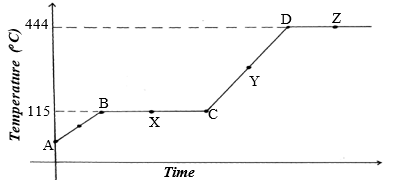
1.  The diagram below shows the heating curve of a pure substance. Study it and answer the questions that follow:


(a) What physical changes are taking place at points X and Z?
(b)Explain what happens to the melting point of sodium chloride added to this substance

2. (a) State two differences between luminous flame and non-luminous flame
     (b) It is advisable to set a Bunsen burner to luminous flame prior to an experiment. Explain

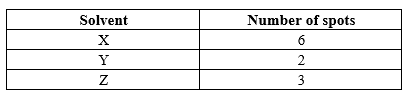
3. The paper chromatography of a plant extract gave the following results:
(a) Which is the most suitable solvent for purifying the extract? Explain
(b) Ball pen cannot be used to mark solvent front in the above chromatography. Explain 4. Name the process which takes place when:
(a) Solid Carbon (Iv) Oxide (dry ice) changes directly into gas
(b) A red litmus paper turns white when dropped into chlorine water
(c) Propene gas molecules are converted into a giant molecule

5. A sample of copper turnings was found to be contaminated with copper (II) oxide. Describe how a sample of copper metal can be separated from the mixture

6. Copper (II) oxide and charcoal are black solids. How would you distinguish between the two solids?

7. a) What is chromatography?

b) Give two applications of chromatography

8. The two elements P and R were separately burned in air, the products gave the results recorded in the table below:
      (a) Suggest the identity of element R. ……………………………………………..……..

      (b) Describe how the nature of the solutions of the of the oxides were determined 
 9. The diagram below represents a paper chromatography for the three brands of soft drinks containing banned artificial food additives.
          
       A and C found to contain the banned artificial food additives. Which numbers indicate the banned artificial food additives? 

10. Without using any laboratory chemical, describe a simple laboratory experiment to distinguish between calcium hydrogen carbonate and sodium hydrogen carbonate

11. Substance Q has a melting point of 15oC and boiling point of 70oC. 
(a) On the same axes, draw the melting point and boiling point graph for Q and the room temperature
(a) State the physical state of substance Q at room temperature

12. Cooking oils comprise of a mixture of compounds which have a boiling point range of 23oC to 27oC.
(i) What evidence is then to support the statement that cooking oil is a mixture? 
 (ii)Name another experimental technique that could be used to confirm your answer in part (i) above

13. A form 1 student carried out the separation as shown in the set-up below:-

i) Identify the method above.................................................................................

ii) Give one of its disadvantages

iii) Name a mixture which can be separated by the set-up above

14. What is meant by melting point and boiling point of a substance?

15. The apparatus below were used by a student to study the effect of heat on hydrated copper II sulphate
17. The diagram below shows chromatograms of blood samples obtained from three athletes. One athlete used illegal drug to improve performance in competition.
(a) Name the line marked M ………………………………………………….

(b)Identify the athlete who used illegal drug ……………... ……………………….

18. Classify the following processes as chemical changes or physical changes

19. Give two reasons why a luminous flame is not used for heating purposes

20. Classify the following processes as chemical changes or physical changes

         Process                                                          physical or chemical
           Neutralization ………………………………………

            Sublimation ………………………………………

              Fractional distillation ………………………………………..

               Displacement reaction …………………………………………

21. Give two reasons why a luminous flame is not used for heating purposes

22. State two criteria for determining the purity of a substance

23. Study the information in the table below and answer the questions. 


i) A mixture contains ethene, Hydrogen and ammonia gases. Explain how a sample of hydrogen gas can be obtained from this mixture.

24. a)i) The diagram below show spots of a pure substance A, B, and C on a chromatography paper. Spot D is that of a mixture 

After development A, B, and C were found to have moved 8cm, 3cm and 6cm respectively. D had separated into two spots which had moved 6cm and 8cm. On the diagram above;
I. Label the baseline (origin)
II. Show the positions of all the spots after development
ii) Identify the substances present in mixture D
b) Describe how solid ammonium chloride can be separated from a solid mixture of ammonium chloride and anhydrous calcium chloride
c) The table below shows liquids that are miscible and those that are immiscible


Use the information given in the table to answer that questions that follow;
i) Name the method that can be used to separate L1 and L2 from a mixture of the two
ii) Describe how a mixture of L2 and L4 can be separated
25. A student left some crushed fruit mixture with water for some days. He found the mixture had fermented. He concluded that the mixture was contaminated with water and ethanol with boiling point of 100oC and 78oC respectively. The set-up of apparatus below are used to separate the mixture.
(i) Name the piece of apparatus labelled W

(ii) What is the purpose of the thermometer in the set-up?

iii) At which end of the apparatus W should tap water be connected?……………………………

(iv) Which liquid was collected as the first distillate? Explain (v) What is the name given to the above method of separating mixture?

(vi) State two applications of the above method of separating mixtures

(vi) What properties of the mixture makes it possible for the component to be separated

by the above methods?

26. The set-up below was used to separate a mixture:-
(a) Name the apparatus missing in the set-up

(b) Give one example of mixture T

(c) What is the name of this method of separation

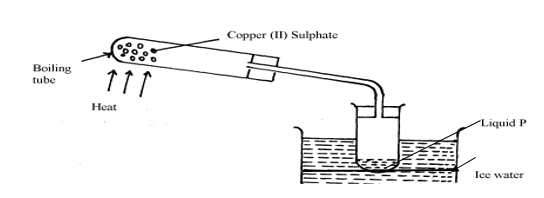
27. a) The diagram below shows a set – up used by a student to find out what happens when Copper (II) sulphate crystals are heated.

   (i) State the observations made when the blue copper (II) sulphate crystals are heated.
(ii) Identify liquid Y and write an equation for its formation.
b) Pellets of sodium hydrogen and anhydrous Copper (II) sulphate were put in separate Petri- dishes and left in the open for two hours. Explain the observation in each Petri-dish. 

28. The chromatography below shows the constituents of a flower extract using an organic solvent:- 


(a) (i) Name a possible organic solvent you can use for this experiment

(ii) State one property that makes the red pigment to move the furthest distance from M

(iii) Describe how one could get a sample of yellow pigment

(iv) On the diagram indicate solvent front

(b) Describe how Aluminium chloride can be separated from a mixture of aluminium chloride

and sodium chloride

29. Study the information below and answer the questions that follow:
            
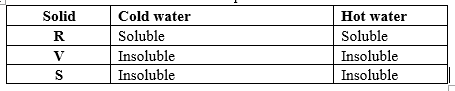
Describe how the mixture of solid R, S, and V can be separated

30. Given a mixture of lead (II) oxide, ammonium chloride and sodium chloride, describe how this mixture can be separated to obtain a sample of each.

31. The setup below was used to separate two miscible liquids Q and T (Boling points; Q =98° C, T=78°C)
(a) Identify the mistakes in the setup above

(b)Identify Distillate X

32. Name the process which takes place when:

(a) Solid Carbon (IV) oxide (dry ice) changes directly into gas.

(b) A red litmus paper turns white when dropped into chlorine water.

(c) Propene gas molecules are converted into a giant molecule.

33. The following diagram shows a paper chromatogram of substances A, B, C, and D which are coloured


(a) Indicate the solvent front on the chromatogram

(b)Which substance is pure? ………………………………………..

(c) Substance E is a mixture of C and D. Indicate its chromatogram in the diagram

34. Study the information below and answer the following questions. A mixture contains three solids A, B, and C. The solubility of these solids in different liquids is as shown below:-
Explain how you will obtain sample C from the mixture

35. State and explain the observations made when iodine crystals is heated in a boiling tube?