This is site is maintained by ERWIN ONYAMBU MOGUSU

Your comment will be highly appreciated,you can contact me on +254733810371 or omogusu@gmail.com.

Erwin in South Korea

Interacting with the Korean students.

ERWIN O. MOGUSU

At Chuncheon National University of Education in South Korea.

Elementally school pupils

Kenyan teachers pose for a photo with the Korean school children.

Travelling to Korea

At Dubai International Airport.

Monday, 28 October 2019

KUPPET Nyamira conducts its BGA


Nyamira BGA was held today. Majority of the participants have commended the organizers of the event for a well-organized meeting. The union members were issued with KUPPET branded T-shits.
KUPPET Nyamira teachers following the proceedings of the BGA

The branch officials looked organised and well prepared for the meeting.
KUPPET Nyamira chairman, Mr. Makaa (far left), introducing the branch officials.

While addressing the teachers, national deputy secretary general Moses Nthurima, thanked the Nyamira teachers for attending the assembly in large numbers. He also appreciated the leadership of other branches who managed to attend the Nyamira BGA. He informed the teachers that even though the meeting was intended for the KUPPET teachers of Nyamira branch, the national office had come to express solidarity with the teachers of Nyamira. In his remarks, Mr. Nthurima noted that every generation has got challenges and opportunities. The opportunity we have today is that we have a new constitution that is one of the most progressive constitutions in the world. The country is today being governed by the rule of law and when we come to the Teachers Service Commission (TSC), they must operate within the parameters of the rules that have been set. He noted that although TSC has not fully democratized the institution, there is a semblance of meeting the teachers and asking their feelings and views.
KUPPET officials taking questions from the audience.

On the issue of democracy, the national deputy secretary general Moses Nthurima, was pleased that there is a team of teachers that are running the issue of BBF in Nyamira. On the national scope democracy has enabled teachers to sit in parliament for instance the KUPPET chairman Mr. Omboko Milemba who is a member of parliament for Emuhaya constituency.
On the next Collective Bargaining Agreement (CBA), the union will be fronting for a harmonized house allowance. According to Mr. Nthurima, every teacher has a right to a decent housing. As at now, a teacher in Nairobi in job group C3 earns KSh 28,000 as house allowance while a teacher in the same job group in Nyamira earns KSh 13,000. “House allowance must be based on job groups and not geography” said Mr. Nthurima.
The union will be negotiating for a 30 – 70 percent increase in salary, risk allowance for science teachers and another risk allowance for all post-primary teachers.
Farther the union will be fronting an idea that TSC should retain a kitty to remunerate teachers who are going out with students. The remuneration of teachers on official duty outside the school should not be left at the discretion of the principals.
TSC should pay overtime to the teachers for time worked outside the working hours.
The notes have been prepared by;
Erwin Mogusu
omogusu@gmail.com
www.omogusu.blogspot.com

Wednesday, 11 September 2019

Digital school of distinction workshop in Nyamira county.


A two-day stakeholders conference of the African digital schools initiative (ADSI) in Nyamira county ended on Tuesday this week. The conference was well attended by school principals, deputy principals, board of management chairpersons and parent association chairpersons.


Participants following the proceedings of the workshop
During the conference the participants were taken through the road-map of the ADSI since its inception in the year 2016. The success, the challenges and the way forward was discussed at length by the stakeholders. The discussions were spearheaded by the panelists who included Dr. Erick Wara (principal, Nyaikuro secondary school), Mr. Jared Monyancha (principal, St. Thomas Moore secondary school), Madam Linet Akenga (principal, Metamaywa secondary school) and Madam Lydia Onyoni (principal Rangenyo girls secondary). The moderators were Mr. George Waithaka (the county project coordinator) and Madam Esther Mwiyeria (ADSI Kenya project manager).

Moderators and panelists during the workshop. From left; Mr. George Waithaka, Madam. Lydia Onyoni, Madam. Linet Akenga, Dr. Erick Wara, Mr. Jared Monyacha and Madam. Esther Mwiyeria.

Dr. Wara, while appreciating the positive impact brought about the ADSI model, he introduced the fact that learners should be allowed to use mobile phones. He argued that phones are a good source of digital content although they may also be abused by learners. ‘’… of course in my school there are computer students who have their own flash disks for the sake of their projects, again this is also prone to abuse…’’ said Dr. Wara. This indicates that mobile phones are not the only technological devices that can abused by learners. The pressure to use these devices is there but there is also the challenge of control. We cannot discard the fact that learners access phones while they are away from school. According to Dr. Wara, the big challenge now is to distinguish between those learners who want to genuinely use the mobile phones to access the digital content and those who want to abuse them.
‘’When you left your house, did you leave the knives in the house? did you leave the gas cylinders? Are you thinking about them?” Madam Esther asked the participants. She went on to answer the questions that even though we have left those items in our houses where children are, we are not thinking about them because we know that the items will be put into good use. She went on to remark that maybe we have not reached there with our learners that they can be left with ICTs and put them into good use.
While addressing the participants, Mr. Jerome Morrissey, the GESCI CEO, did not resonate with the idea of learners accessing and using mobile phone. He cited the issues of cybercrimes and misuse of the phone by the learner. He argued that if the learners have to use the mobile phones, then the content that they can access should be filtered. This means that the schools will have to be connected to a particular network which can be very costly. Mr. Morrissey encouraged teachers to incorporate at least one 21st century skill in each of their lessons. He argued that the 21st century skills cannot be taught separated, they have to be include the subjects already in the curriculum.
GESCI CEO, Mr. Jerome Morrissey
Away from the debate of mobile phones, the participants, panelists and invited guests commended the ADSI model for its numerous positive impact it has had on the schools where it is being implemented. The invited guests who addressed the participants included Mr. Wilson Koros (Nyamira TSC county director) and Dr. Anyan’g (C.D.E Nyamira). Madam Esther challenged the participating schools to find a mechanism of holding the hand of the other schools that are not on the program so that that they can also reap from the benefits of ADSI model.
C.D.E Nyamira county, Dr. Anyan'g (third from right)
The county project coordinator, Mr. Waithaka thanked all the participants for attending the conference and participating actively. The conference ended with the participating schools awarded certificate of e-confidence stage in the implementation of the ADSI model.
Mr. Mabeya, the school based coordinator at Gesiaga secondary school receives the school e-confident certificate from the program manger, Mr. Senthil Kumar.

Thursday, 29 August 2019

Joining KUPPET


~Are you willing to join KUPPET?
~ Are you paying agency fee and would like to join KUPPET?
~ You are in KNUT and you have made the decision to join KUPPET?

Do not wait lose your salary and be taken back to salary scale of 2016. By joining KUPPET you have will made the right choice of continuing to gain the benefits of the current CBA.

*TO JOIN KUPPET FOLLOW THIS PROCEDURE*
1. Log in to Payslips online
2. Go to *Send payslip to third party*
3. On category, select *SWA.*
4. On Company, select *KUPPET UNION DUES*
5. Then *Click or Press send payslip*
6. After successfully sending your payslip to KUPPET Union Dues *SMS/ WhatsApp your TSC NO and Name to 0723839280 (Mr. Kimotho)*

*TO WITHDRAW FROM KNUT*

1. Log in to TSC online Payslips.
2. Go to third Party Section 3. Go to UNION MEMBER VALIDATION
4. Press the small box on the far right against KNUT
5. Press Stop Union Membership button.

*NOTE*
After successfully sending payslip, please Send your *TSC NO and Name to 0723839280 (Mr. Kimotho)* for onward transmission to Nairobi for immediate processing.

Thursday, 22 August 2019

Census questions you will be asked when the exercise begins

  • What are the names of each person who spent the night of 24th/25th August, 2019 in this household?
  • What is each person’s relationship to the head of this household?
  • What is their sex ?
  • What is their age (s)?
  • What is their date of birth?
  • Please insert line number of their biological mother
  • Is the person a usual member of this household?
  • What is their ethnicity or nationality ?
  • What is their religion ?
  • What is their marital status?
  • Where were they born?
  • Where were they living in August 2018?
  • When did they move to the current county?
  • Why did they move to the current place of residence?
For women older than 12 years, questions will be as follows:
  • How many children have you ever  borne alive?
  • How many children have you borne  alive who usually live in this household ?
  • How many children have you borne alive who usually live elsewhere ?
  • How many children have you borne   alive who have died ?
  • When was your last child born?
  • Where did this last birth occur?
  • What was the sex of this child/ children?
  • Was this last birth notified?
  • Is this last child/ children still alive ?
  • If the last child is not alive, when did the child die?

Tuesday, 13 August 2019

Chemical families

1. Study the information in the table below and answer the questions that follow:
(a) Would these form part of a metallic or a non-metallic group? Explain
(b) Suggest an element in the table above likely to be the most reactive. Explain

2 State the reason for using Argon in electric light bulbs

3. Study the information in the table below and answer the questions that follow. The letters do not represent the actual symbols of the elements.
(a) What is the general name given to the group in which the elements X, Y and Z belong?

(b) Select two elements which are coloured gases

(c) Explain why Z has the highest boiling point

(d) Write an equation for the reaction of element Z with iron metal

(e) Element Y was dissolved in water and a piece of blue litmus paper was put into the resulting solution. State and explain the observation that was made on the litmus paper

4. The table below shows elements A, B, C, E, F, and G. Elements in group X have a valency of 2 while elements in group Y have a valency of 1. Use the table to answer the questions that follow:-
(i) Atomic radius increases from A to C and from E to G. Explain
(ii) Explain the difference in the atomic and ionic radii of group X elements
(iii) Elements C and G belong to the same period. Explain why the atomic radius of C is greater than that of G
(iv) Give the formula of the compound formed when B and F react
(v) What type of bonding is formed in the compound above? Explain
(vi) Starting with the least reactive, arrange the elements in group Y in the order of reactivity. Explain:

5. The information in the table below relates to elements in the same group of the periodic table.
Study it and answer the question that follows.
Which element has the highest ionization energy? Explain

6. Starting with Lead (II) carbonate explain how you would prepare a pure sample of Lead (II) sulphate

7. a) What is an isotope?
b) An element Q consists of 3 isotopes of mass 28, 29, 30 and percentage abundance of 92.2, 4.7, 3.1 respectively. Determine the relative atomic mass of the element?

8. Study the information in the table below and answer the questions that follow. (The letters do not represent the actual symbols of the elements)
(a) What is the general name given to the group in which elements P, Q and R belong?
(b) Explain why P has the highest ionization energy
(c) Write a balanced chemical equation for the reaction between element Q and water

Monday, 12 August 2019

Nitrogen and its compounds

1. The apparatus below was set-up to show the catalytic oxidation of ammonia. Study the diagram and answer the questions that follow:-

(i) Write an equation for the reaction that takes place
(ii) Why is it necessary to have a hot nichrome wire in the gas jar?
(iii) Write the formula of the complex ion formed when excess ammonia gas is passed through
a solution containing Zn2+  ions

2. The diagram below shows the catalytic oxidation of ammonia gas. Use it to answer the
questions that follow:-

(a) What metal could rod M be made of?
(b) State and explain two observations made inside the conical flask

3. Ammonia gas is prepared in the laboratory by the action of an alkali on an ammonium salt. A student wanted to prepare a sample of ammonia gas in the laboratory.
(a) Give one alkali that can be used in the above experiment
(b) Write an equation for the reaction that takes place in the above experiment

4. (a) Explain the importance of the high percentage of nitrogen in air
(b) Why is nitrogen used for storage of semen in artificial insemination?

5. The diagram below is used in preparation of a gas in the laboratory. Answer the questions that follow;
(a) Name gas X …………………………………………………………………………..
(b) State one physical property which makes it possible for the gas to be collected as shown
(c) State one commercial use of gas X

6 Study the flow charts below and use them to answer the questions that follow:
(a) Identify possible cations present in:
(i) Solution A
(ii) Solution B
(b) State and explain the observations made when a sample of dry white precipitate B is
heated in a test-tube
7. The set-up below is an arrangement showing how metals react with nitrogen (IV) oxide.
Study it and answer the questions that follow:-
(a) Nitrogen (IV) oxide is passed through the combustion tube before copper is heated. Give a reason for this
(b) State the observations that would be made at the end of the experiment in the combustion tube
(c) Name gas N ……………………………………………………………………..

8. (a) In haber process hydrogen and nitrogen react in the presence of finely divided iron catalyst. Explain why the catalyst is finely divided
(b) A mixture of N2, H2 and NH3 was bubbled through 0.2M hydrochloric acid solution. The final concentration of the acid was found to be 0.1M. Give explanation

9. In an experiment, a few drops of concentrated nitric acid were added to aqueous iron II sulphate in a test-tube. Excess ammonia solution was then added to the mixture
(a) State the observations that were made when:-
(i) Concentrated nitric acid was added to aqueous iron (II) sulphate
(ii) Excess ammonia was added to the mixture
(b) Write an ionic equation for the reaction which occurred in a (ii) above

10. The chart below shows a summary for the preparation of nitrogen gas from air
(a) What is the purpose of the sodium hydroxide?
(b) Write an equation for the reaction taking place in chamber II
(c) The nitrogen gas obtained is not pure. Explain

11. Dilute nitric acid is added to excess green solid. Effervescence occurs and a blue solution is formed. When excess ammonia solution is added to a sample of the solution a deep blue solution is formed
(a) Identify the anion and cation in the green solid:
(b) Write an ionic equation for the reaction forming deep blue solution

12. The diagram below is a set-up for preparation and collection of a gas. Study it answer the questions that follow:
(i) Identify gas X ………………………………………………………….
(ii) Write an equation for the formation of gas X
(iii) What precaution should be observed when preparing gas X by the above method?
(iv) Describe the suitable drying agent for gas X
(v) How can one confirm that the gas collected is gas X?
(vi) State two physical properties of gas X
(b) The diagram below is a set-up used in preparation of ammonia solution. Study it and answer
the questions that follow
(i) What is the purpose of the filter funnel in the set-up above?
(ii) What would happen if a delivery tube was used in place of the filter funnel?
(iii) What observation would be made on litmus paper placed into the solution in the beaker at the end of the experiment?

13. The following flow chart shows the industrial manufacture of Nitric (V) acid.
a) Identify substance B, C, E and F.
b) Describe what happens in the catalytic chamber
c) State what takes place in chamber D.
d) 60 – 65% nitric (V) acid is produced in the absorption chamber. Describe how the acid can be concentrated.
e) State why nitric (V) acid is stored in dark bottles.
f) Copper reacts with nitric (V) acid and not hydrochloric acid. Explain.

14. The flow chart below illustrates two industrial processes, Haber process and the Contact process:
(i) Give the name of the process by which air is seperated into oxygen and nitrogen
(ii) Apart from oxygen and nitrogen gases produced from process (a)(i) Name one other gas produced
(b) Name the substances represented by the letters A, B, C and E
(c) Name the catalysts used in:
(i) Haber Process ……………………………………………………………………..
(ii) Contact Process ……………………………………………………………………..
(d) Explain the role of the catalysts in both the Haber and the Contact processes
(e) Write a chemical equation for the formation of compound B
(f) Calculate the percentage by mass of the nitrogen present in compound D
(g) Give one major use of compound E

15. The diagram below represents a set-up used to obtain nitrogen from air. Study it and
answer the questions that follow:-
(i) Name solid Q ........................................................................................
(ii) What is the purpose of sodium hydroxide
(iii) Write an equation for the reaction which took place in tube “P
(iv) Give the name of one impurity in the nitrogen gas obtained
(v) Give a reason why liquid nitrogen is used for storage of semen for artificial insemination
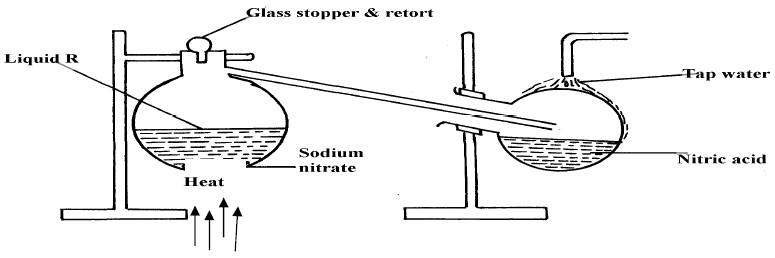
(b) The set-up below was used to prepare nitric acid.
(i) Give the name of liquid ‘R’ .........................................................................
(ii) Explain the following:-
(a) Nitric acid is stored in dark bottles
(b) The reaction between copper metal with 50% nitric acid in an open tube gives brown fumes

16. Study the flow chart below and answer the questions which follow:
(i) Give one source of the following raw materials
(a) Nitrogen gas ………………………………………………………………………………..
(b) Hydrogen gas …………………………………………………………………………………..
(ii) State three conditions required in process I
(iii) Name: catalyst P…………………………………………………………………
Gas M……………………………………………………………………..……
(iv) Write chemical equations for;
(a) Formation of gas M
(b) The reaction in the absorption tower
(v) Give two reasons why step IV is necessary
(vi) Describe how you would test if a given liquid is a nitrate
(vii) Give three uses of nitric acid

17. The diagram below shows the apparatus for the laboratory preparation of one of the oxides
of Nitrogen
a) (i) Name the gas being produced
(ii) Write the equation for the thermal decomposition of ammonium Nitrate
(iii) The gas is being collected over hot water. Explain
(iv) State and explain the observations made when burning sulphur is lowered into a gas jar containing the gas
(b) (i) Name the catalyst used during catalytic oxidation of ammonia
(ii) Nitrogen (IV) oxide is the final product during catalytic oxidation of ammonia. Write a chemical equation for its formation
(iii) State two physical differences between Nitrogen (I) oxide and Nitrogen (IV) Oxide
(c) Nitric acid is prepared in the laboratory by action of concentrated sulphuric (VI) acid on a suitable Nitrate and distilling off the Nitric acid, in all glass apparatus.
(i) Why must the apparatus be made of glass?
(ii) Hot concentrated Nitric acid reacts with sulphur in the equation below:-
   
(I) Identify the species :-
Oxidised ………………………… Reduced …………………………………
(II) Pure nitric acid is colourless but the product during its preparation is usually pale yellow.
Explain
18. a) Describe the process by which oxygen can be obtained from air on large scale
b) The flow chart below shows the industrial manufacture of nitric (V) acid
i) Identify substances X and Y
ii) Write an equation for the reaction taking place in the absorption tower
iii) The concentration of the acid obtained is about 60%. How can this concentration be increased to about 65%?
iv) A factory uses nitric (V) acid and ammonia as the only reactants for the production of a fertilizer. If a mass of 9600kg of fertilizer was produced, calculate the mass of ammonia gas needed
(N = 14, H = 1, O = 16)
(a) Name another substance which can be used instead of sodium hydroxide
(b) What is the function of filters?
(c) Identify the substance removed at step III
(d) At what temperature does liquid oxygen distil?
(e) Identify process X
(f) Describe how process X occurs
(g) I. State one industrial use of Nitrogen
(II) Air is a mixture but not a compound. Give two reasons

20. Using chemical equations show the bleaching actions of chlorine and sulphur(IV)oxide

21. The diagram below represents an in complete set-up for preparation of a dry sample of gas R
a) Complete the set-up to show how a dry sample of gas R is collected
b) Write a chemical equation for the reaction that produces gas R

22. The diagram below was used to investigate the reaction between nitrogen(I)oxide and copper
turnings. Study it and answer the questions that follow:
a) What has been omitted in the set-up? (show it on the diagram)
b) Write a chemical equation for the reaction that took place in the combustion tube
c) State one use of gas P

23. When sulphur powder is heated to over 400o the following changes are observed:- At 113oC it melts into light brown liquid. The liquid then darkens to become reddish-brown and very viscous at 160oC. Above 160oC the liquid becomes almost black. At the boiling point the liquid becomes mobile. Explain these observations

24. Concentrated sodium chloride (Brine) was electrolysed using platinum electrodes.
What would be the difference in terms of products at each electrode if dilute sodium chloride
solution was used in place of brine. Explain

25. (i) Nitrogen (I) Oxide supports, combustion of burning charcoal. Write an equation
to show this reaction
(ii) Ammonium nitrate can be heated to give off nitrogen (I) Oxide. However, a mixture
of NH4Cl and NaNO3 is preferred. Explain
(iii) Ammonia turns wet red litmus paper blue. Which ion is responsible for this reaction

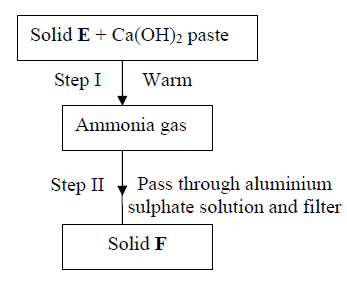
26. Study the scheme below and answer the questions that follow:
(a) Name solids E and F
(b) Write down a balanced equation for the reactions that lead to formation of solid F

27. When a few drops of aqueous ammonia were added to a colourless solution X, a white
precipitate was formed. On addition of more aqueous ammonia, the white precipitate
dissolved to a colourless solution Q
(a) Name the white precipitate formed
(b) Write formula of the complex ion present in the colourless solution Q
(c) Write an ionic equation for the formation of the white precipitate

28. The first step in the industrial manufacture of nitric cid is the catalytic oxidation of ammonia gas.
a) What is the name of the catalyst used?
b) Write the equation for the catalytic oxidation of ammonia gas.
c) Nitric acid is used to make ammonium nitrate. State one use of ammonium nitrate.

29. Explain what is observed when ammonia gas is bubbled into Copper (II) sulphate solution till in excess.

30. (a) State the conditions under which nitrogen react with hydrogen to form ammonia during Haber process
(b) When dry ammonia gas is passed over hot copper (II) Oxide, a shinny brown residue and a colourless droplets are formed. Explain these two observations

31. Study the flow chart below and answer the questions that follow
(a) State the observation made when ammonia is passed over heated Copper (II) Oxide
(b) Identify:-
(i) Gas A ………………………………………….………
(ii) Liquid B ………………………………..…………………

Carbon and its compounds

1. (a) State one use of graphite

(b) Both graphite and diamond are allotropes of element Carbon. Graphite conducts electricity whereas diamond does not. Explain

2. Below is a simplified scheme of solvay process. Study it and answer the questions that follow:
a) Identify gas R.
b) Write an equation for the process III.
c) Give one use of sodium carbonate.

3. A burning magnesium continues to burn inside a gas jar full of carbon (IV) oxide. Explain.

4. The diagram below shows a jiko when in use
(a) Identify the gas formed at region H
(b) State and explain the observation made at region G
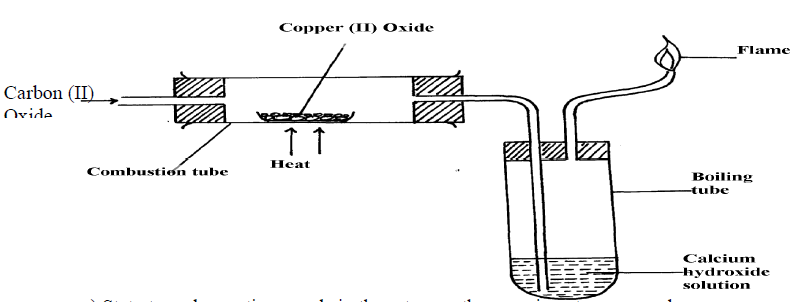
5. Study the diagram below and use it to answer the questions that follow.
(a) State the observation made in the combustion tube.
(b) Write an equation for the reaction that took place in the combustion tube
(c) Give one use of P

6. (a) Identify two substance that are reacted to regenerate ammonia gas in the solvary process
(b) Write down a balanced chemical equation for the reaction above

7. When the oxide of element H was heated with powdered Carbon, the mixture glowed and Carbon (IV) oxide was formed. When the experiment was repeated using the oxide of element J, there was no apparent reaction
(a) Suggest one method that can be used to extract element J from its oxide
(b) Arrange the elements H, J and Carbon in order of their decreasing reactivity

8. (i) Diamond and silicon (IV) Oxide have a certain similarity in terms of structure and bonding. State it
(ii) State one use of diamond

9. (a) What is allotropy?
(b) Diamond and graphite are allotropes of Carbon. In terms of structure and bonding
explain why graphite conducts electricity but not diamond

10. The diagram below shows a charcoal stove with different regions
(a) Write an equation for the formation of the product in region B
(b) How would one avoid the production of the product at B? Give a reason for your answer

11. Study the diagram below and answer the questions that follow:
(a) Explain the observation made in the combustion tube during the experiment
(b) Write an equation for the reaction that takes place in the combustion tube

12. Diamond and graphite are allotropes of carbon:-
(a) What is meant by allotropes?
(b) How do they differ in their structure and bonding

13. Study the experimental set-up below:
a) State two observations made in the set up as the experiment progressed
b) By use of a chemical equation, explain the changes that occurred in the boiling tube
c) Why was it necessary to burn the excess gas?

14. The diagram below shows the heating curve of a pure substance. Study it and answer the
questions that follow:
points A and C
(d) The substance under test is definitely not water; Give a reason for this
(e) What would happen to the melting point of this substance if it were contaminated with sodium chloride?
(f) What happens to the temperature between points B and C?

15. Study the set-up below and answer the questions that follow:
(a) (i) Name Gas X ………………………………………………………………
(ii) State the effect of releasing gas X to the environment
(b) Write down equations for the reactions taking place in;
(i) Tube I
(ii) Tube II
(iii) Flask
(c) State the observation made in tube III
(d) Write down an equation for the reaction which could be used to generate Carbon
(IV) Oxide for the above set up
(e) Name the reagents used to generate gas x in the laboratory
(f) Complete the diagram above to show how excess gas x can be collected

16. The figure below shows the stages in the manufacture of sodium carbonate. Study the diagram
below and use it to answer the questions that follow.
a) (i) Name three starting materials in the manufacturer of sodium carbonate.
(ii) Which substances are recycled in this process?
(iii) Identify the chambers in which the recycled substances are regenerated.
(iv) Name the substances U and V.
b) Give an equation for the reaction which occurs:
(i) In the reaction chamber 1
(ii) When solid V is heated.
(iii) In the reaction chamber 3.
c) State one commercial use for
(i) Sodium carbonate.

17. The set-up below was used to prepare dry carbon (II) Oxide gas. use it to answer the questions
below it:
(a) (i) State two mistakes committed in the set-up arrangement above
(ii) The student produced carbon (IV) oxide gas from the reaction between Lead (II) Carbonate
and dilute hydrochloric acid. The gas was produced for a short time and the reaction came
to a stop. Explain
(iii) Write the equation for the reactions taking place in the combustion tube and the conical
flask:
Combustion tube:…………………………………………………………………..
Conical flask ……………………………………………………………………..
(iv) State one use of carbon (IV) Oxide gas apart from fire extinguisher
(v) Give two properties that make carbon (IV) Oxide to be used as fire extinguisher

(b) 

Which property of carbon (II) Oxide is demonstrated by the above equation?
(c) Aluminium carbonate does not exist. Give a reason
(d) Ammonium carbonate decomposes when heated. Write a chemical equation to
represent this decomposition

18. State and explain the observation made when a piece of charcoal is dropped in a jar containing concentrated nitric (V) acid

19. When Carbon (IV) oxide is passed through lime water, a white precipitate is formed but when excess Carbon (IV) Oxide is passed, the white precipitate disappears;
(a) Explain why the white precipitate disappears
(b) Give an equation for the reaction that takes place in (a) above
20. The set-up below was used to prepare a carbon (II) oxide gas.
(a) Give the name of substance A ………………………………………………………….
(b) Complete the diagram to show how the gas can be collected
(c)Write the equation for the reaction